Friday, October 7, 2011

Effective PowerPoint Presentation

Hello everybody!

I had such a wonderful Wednesday morning in your company; thank you!

Thank you also very much for your comments on the class blog and twitter.

As many of you mentioned, a PowerPoint can take many forms. In some occasions a PowerPoint is used to sell a product or an idea, other times it is used to present the results of a study. In all cases, the PowerPoint must target an audience and must be created with a precise objective in mind. Mine was containing more text that I’m usually comfortable with. The reason for so much text was that I wanted you to use my PowerPoint as notes that you can refer to later during the semester. In other words, I have adjusted my presentation to my audience’s (you) needs.

The best piece of advice is obviously to have fun and to be creative while making and presenting your PowerPoint. This is also an advice that I try to apply in my life in as many situations as possible!!

Have a great weekend!

MC

Wednesday, October 5, 2011

Lecture 13: Powerful Presentations

Today Marie-Claude will give the lecture on how to make strong, professional presentations.
Image from here.

Tuesday, October 4, 2011

Module 5: Slick Presentations

Being a good presenter is not just about using the right words and maintaining strong body language, but it's also about an engaging powerpoint. Here is a post from Jessica Meher that highlights some slick presentations that definitely kill the "death by powerpoint" feeling.


1. Clean Pitch to the Enterprise
Trademark Interactive helps companies improve their pay-per-click campaigns using sophisticated algorithms to control bidding. In this presentation, they’ve boiled down their math to arrive at a critical point that resonates—a 23% improvement—and therein lays the coup. Marketers fall over themselves trying to do 23% better in almost anything.


2. Beautiful Media Barons
TV producers and media companies rely on top-notch presentations to woo the business of prospective advertisers. Discovery Communications, producers of well-known channels including Animal Planet, Discovery Channel, and TLC, set the bar high with outstanding presentations that come to life onscreen, such as this one.


3. Hire Me
When was the last time you saw a cover letter packaged up as an online presentation? This presentation shows creative initiative and instantly separates the author from the crowd. It goes without saying that this applicant got the interview. Get ready to see more of these—both cover letters and “presumes.”


4. Dramastic
Translation? Dramastic means dramatic, fantastic, and even a little bit of drastic. So here they are— Dramastic Presentations of the Decade. From climate change to Google search to credit crisis to tweeting from outer space, there’s a presentation for everything.


5. Dear Impassioned Traveler
It’s true; you don’t need a giant designer’s budget to create a presentation that turns heads. Tread Light Travels is an up and coming travel agency offering unique tour programs in Brazil. Their passion and expertise comes through clearly in this presentation, not to mention the great color scheme and effective use of voice-over that leave a lasting impression.


6. Lifting the SlideRocket Hood
To stretch your mind a bit, check out the SlideRocket presentation builder overview. On top of being an excellent presentation in its own right, these slides lift the hood on powerful features not typically associated with presentations, including presentation analytics, live Twitter feeds, lead generation forms, collaboration, web meetings and a gaggle of other innovative capabilities.


7. Presentation News Release
It's always great to link great content with your press releases, and a "presentation news release" may just fit the bill for you. With pleasing music and slide transitions, this presentation no doubt was a boost for Rumblefish.


Monday, October 3, 2011

Module 5: Labs

This week in the lectures we are focussing on ways to disseminate our research. In the labs, we'll get to practise two main ways. We'll be making a poster (from a science article) and we'll then have to present that poster. The latter will be graded by the TAs in class.

Here is the rubric for the poster presentation you'll give at the end of the lab. Take a look so you'll have an idea of what you need to include in your poster: https://docs.google.com/document/d/1CTk9FMWoEhSrMEeauMfjEYgcLU5Vl7L-GYORVj4Xq08/edit?hl=en_US


Also have a read of this reference guide to creating posters: http://www.ncsu.edu/project/posters/NewSite/documents/QuickReferenceV3.pdf


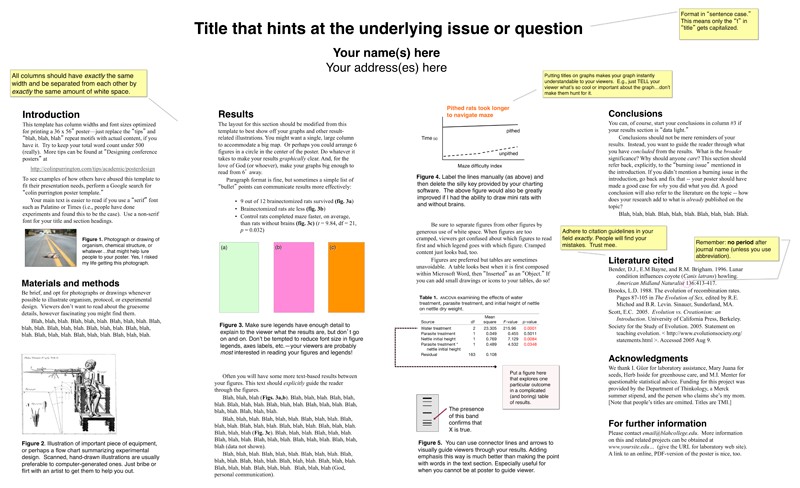
Colin Purrington has this useful template for a poster that you might want to follow:


Here are some examples of how NOT to design a poster:

Image from here: http://www.bio.miami.edu/ktosney/file/Bad8X10.pdf


Pecha-kucha (Pecha-k-cha)

The Module 4 lab was a real fun and a very good learning exercise for the students. In D2 section lab we did a pecha-kucha style presentation, a 10x20 format. We had 7 presentations on various topic from food and nutrition to textile to conservation biology.

The topics are:

1. How to Create a Quick and Nutritious Recipe.
2. A Holistic Overview of Everyday Textiles.
3. Canadian Food Guide.
4. Four Major Food Groups.
5. From Pasture to Plate
6. Conservation and the Oil Sands
7. Food Waste and Management.

In this lab exercise we learn that how important it is to know the exact content of each slides
of your presentation and we also understand the fact that 'a picture tells thousand words'.

The upcoming lab will be fun as well, poster is a wonderful way of communication.
Hope to see some wonderful presentations D2 Lab.

Sunday, October 2, 2011

Lecture 12: Disseminating Information


This week, Module 5, we will be looking at various ways of sharing our own research. We will cover the idea of posters and academic papers as well as have an opportunity in the labs to practise presenting a poster.


On Monday we have a special visitor, Maira Quintanilha will be coming to give us a short presentation on how she made her poster that WON at the AIHN graduate student competition.

Here is a brief bio of Maira:


Maira Quintanilha began her Master in Science program at the Department of Agricultural Food and Nutrition Sciences at University of Alberta in the Fall of 2009 after completing a Bachelors degree in Nutrition and Food Science and the Integrated Dietetic Internship Program from the Federal University of Goiás in Brazil. 
During her Masters degree at the University of Alberta, Maira has received many awards and scholarships including the Dr. Elizabeth A. Donald MSc Fellowship in Human Nutrition, second place in the 2011 Alberta Institute for Human Nutrition graduate poster competition and two Graf tuition awards. She was also a finalist in the prestigious Nestlé Student and Trainee Competition at the Canadian Nutrition Society Conference in 2010. Her research interests include health promotion, building a school environment that facilitates healthy choices, and nutrition education. She defended her Masters thesis in August 2011 and is currently working on her process to become a Registered Dietitian in Canada.

HOMEWORK: There is a slight change as Marie Claude will be giving a guest lecture in the next class so FOR FRIDAY: please bring to class a paper/article that you have to read for one of your other classes


Lecture Part I: Effective Posters


Lecture Part II: Academic Essay Writing


Group Essay Writing Activity:
https://docs.google.com/document/d/16FhezNuYEFECx8lDy7ctaT2EDkIxoUjDnZquqbwPxS8/edit?hl=en_US


Remember to comment on the blog with any core questions/ideas pertaining to lectures (see Participation on the syllabus) 


Note: I have had a few students ask me about a CV. It is like a résumé, but more detailed. Here is what Colorado State University says:


How a CV is Different from a Resume
Many job search committees for teaching, graduate school, international or research positions request a CV to get a fuller picture of your academic experiences, accomplishments and interests than a resume can provide.
A resume lists your education, experience and skills. Your CV allows you to go beyond listing your relevant experiences and accomplishments; you can also convey the substance of those experiences and accomplishments.
Unlike a resume, which is usually about one page long, CVs vary in length, from about two to five pages, depending on the applicant's relevant experiences.

Pecha ohh Kucha

Last week's lab was fun as usual. The students in the Monday lab formed groups of at least three members each. They clustered according to their programs of study or passions (that were related to their programs of study). After about 45 minutes of 'Pecha' development, it was time to show the whole class what they had prepared. Each group brought something unique in their presentations. These ranged from slide designs to the order of presentations. We had some glitches though, some groups had problems with their 'slide timings'. After each presentation, other students and I evaluated each group's performance and pointed out some areas of public presentation that required some attention. This was a good opportunity for other students watching to acquire some presentation skills.

The Tuesday lab had the same structure with the Monday lab. The students all developed their presentations in about 40 minutes!!! The funny part of it was that we had 50 minutes for the lab since another class was waiting. We managed to get two groups to present their slides. I told the others that they would present theirs in the next lab, with the hope that we will have time.

Pecha Kucha _ quick fun!

The Pecha Kucha lab was a huge success!

I was very impressed with the students' ability to design Powerpoint presentations quickly and work together in groups.

The topics that were covered were:

The Effects of Drinking
Saving the Environment
Depression and University Students
The Health Effects of Drinking

These students are definitley driven to promote health and well-being!


I found this interesting article on Science Daily. Thought some of you might be interested to learn about how we recognize faces - an important aspect of communication.

http://www.sciencedaily.com/releases/2011/09/110929122753.htm


I think this up coming lab this week will be very helpful for the students. Making good posters is not easy!

Saturday, October 1, 2011

Lab update

The labs have been going very well and the students are very excited about their Community Service-Learning (CSL) placements! I have students that are completing placements in

Voices for Choices
Writer's Guild of Alberta
Alberta Caregivers Association
U of A's InforLink
and U of A's Sustain SU (Formerly ECOS)

They are using their knowledge, skills and abilities, some of which they previously had and are enhancing and some of which they are developing now, from this course to assist the organizations with their communications, outreach and various other projects. The students have all been posting on their own blog of their experiences with their projects and are in the midst of all the action right now!

In labs we have been troubleshooting issues with, for example, how to deal with organizing all their social media and online tools they are using (e.g. keep the same login and password for all, but what security issues does this pose...?) as well as discussing topics related to balancing community service with school work, "work" work (we all gotta eat!) and trying to have some of a social life. They are just like grad students, I swear! ;)

This coming week we are looking forward to competing the poster activity, and seeing how creative and yet professional we can all be. A lesson learned first-hand in this was creating their professional facebook pages. They look great!

Looking forward to the conintued work these students put forward and learning as much from them as I hope they can learn from me!

Courtney :)