Being a good presenter is not just about using the right words and maintaining strong body language, but it's also about an engaging powerpoint. Here is a post from Jessica Meher that highlights some slick presentations that definitely kill the "death by powerpoint" feeling.
1. Clean Pitch to the Enterprise Trademark Interactive helps companies improve their pay-per-click campaigns using sophisticated algorithms to control bidding. In this presentation, they’ve boiled down their math to arrive at a critical point that resonates—a 23% improvement—and therein lays the coup. Marketers fall over themselves trying to do 23% better in almost anything.
2. Beautiful Media Barons TV producers and media companies rely on top-notch presentations to woo the business of prospective advertisers. Discovery Communications, producers of well-known channels including Animal Planet, Discovery Channel, and TLC, set the bar high with outstanding presentations that come to life onscreen, such as this one.
3. Hire Me When was the last time you saw a cover letter packaged up as an online presentation? This presentation shows creative initiative and instantly separates the author from the crowd. It goes without saying that this applicant got the interview. Get ready to see more of these—both cover letters and “presumes.”
4. Dramastic Translation? Dramastic means dramatic, fantastic, and even a little bit of drastic. So here they are— Dramastic Presentations of the Decade. From climate change to Google search to credit crisis to tweeting from outer space, there’s a presentation for everything.
5. Dear Impassioned Traveler It’s true; you don’t need a giant designer’s budget to create a presentation that turns heads. Tread Light Travels is an up and coming travel agency offering unique tour programs in Brazil. Their passion and expertise comes through clearly in this presentation, not to mention the great color scheme and effective use of voice-over that leave a lasting impression.
6. Lifting the SlideRocket Hood To stretch your mind a bit, check out the SlideRocket presentation builder overview. On top of being an excellent presentation in its own right, these slides lift the hood on powerful features not typically associated with presentations, including presentation analytics, live Twitter feeds, lead generation forms, collaboration, web meetings and a gaggle of other innovative capabilities.
7. Presentation News Release It's always great to link great content with your press releases, and a "presentation news release" may just fit the bill for you. With pleasing music and slide transitions, this presentation no doubt was a boost for Rumblefish.
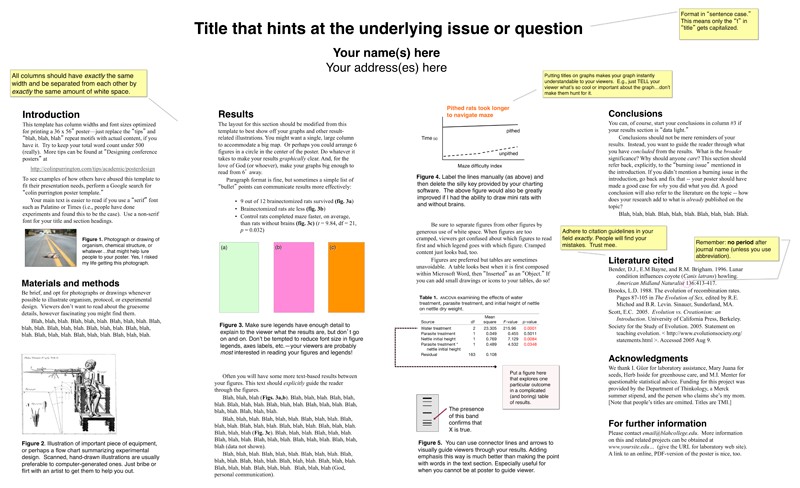
This week in the lectures we are focussing on ways to disseminate our research. In the labs, we'll get to practise two main ways. We'll be making a poster (from a science article) and we'll then have to present that poster. The latter will be graded by the TAs in class.
This week, Module 5, we will be looking at various ways of sharing our own research. We will cover the idea of posters and academic papers as well as have an opportunity in the labs to practise presenting a poster.
On Monday we have a special visitor, Maira Quintanilha will be coming to give us a short presentation on how she made her poster that WON at the AIHN graduate student competition.
Here is a brief bio of Maira:
Maira Quintanilhabegan her Master in Science program at the Department of Agricultural Food and Nutrition
Sciences at University of Albertain
the Fall of 2009 after completing a Bachelors degree in Nutrition and Food
Science and the Integrated Dietetic Internship Program from the Federal
University of Goiás in Brazil.
During
her Masters degree at the University of Alberta, Maira has received many awards
and scholarships including the Dr. Elizabeth A. Donald MSc Fellowship in Human
Nutrition, second place in the 2011 Alberta Institute for Human Nutrition
graduate poster competition and two Graf tuition awards. She was also a
finalist in the prestigious Nestlé Student and Trainee Competition at the
Canadian Nutrition Society Conference in 2010. Her research interests include
health promotion, building a school environment that facilitates healthy
choices, and nutrition education. She defended
her Masters thesis in August 2011 and is currently working on her process to
become a Registered Dietitian in Canada.
HOMEWORK: There is a slight change as Marie Claude will be giving a guest lecture in the next class so FOR FRIDAY: please bring to class a paper/article that you have to read for one of your other classes
•Remember
to comment on the blog with any core questions/ideas pertaining to lectures
(see Participation on the syllabus)
Note: I have had a few students ask me about a CV. It is like a résumé, but more detailed. Here is what Colorado State University says:
How a CV is Different from a Resume
Many job search committees for teaching, graduate school, international or research positions request a CV to get a fuller picture of your academic experiences, accomplishments and interests than a resume can provide.
A resume lists your education, experience and skills. Your CV allows you to go beyond listing your relevant experiences and accomplishments; you can also convey the substance of those experiences and accomplishments.
Unlike a resume, which is usually about one page long, CVs vary in length, from about two to five pages, depending on the applicant's relevant experiences.