Thank you so much everyone for coming today to our final class.
Thank to you the CSL students who bravely gave wonderful presentations (using Prezzie!) about their placements. They all taught us a lot about not-for-profits organizations and what goes on at the University and in the local area.
Thank you also to the three students, Kelsey, Annalise and Julianna, who created a visual and musical wrap-up of the term using social media! Amazing work!
Showing posts with label creative. Show all posts
Showing posts with label creative. Show all posts
Wednesday, December 7, 2011

Lecture 35: Final Day of Classes
Hi everyone!
And here we are, on the very last day of ALES204 - I know you'll miss it! :)
REMINDER: Your E-portfolio is due today by 17:00. Please send the link to your blog to your TA. And, don't forget to include the links to your FIVE comments in your final blog post.
I'd like to thank you all for coming to class and participating both in class and through the class blog, your blogs and twitter. I'd also like to wish you all a lovely festive season. On that note, here is a video from 16 year old Winnipeg student Sean Quigley, who harnessed social media (youtube) and is now famous: a Canadian wintery rendition of The Little Drummer Boy.
On our last day, as mentioned, we will have the exciting Pecha Kucha presentations for the CSL students. They are going to share with us a little bit about what they've been working on this term. Perhaps you'll be so interested, you'll want to enroll in CSL in another term.
After the Pecha Kucha presentations I would like you all to take about 10 minutes to answer a survey I've created. I'm very interested to hear your thoughts on the course, what you learnt and perhaps what you would still like to learn. I'll use this information in my next course design! I appreciate your input and your participation.
You can fill in the form right here (scroll down a bit) or access the google doc (but of course!) here. Note, feel free to work with a partner.
And finally, we'll conclude our class with a special send-off from three of your classmates, Kelsey MacDonald, Julianna Damer and Annalise Young.
And here we are, on the very last day of ALES204 - I know you'll miss it! :)
REMINDER: Your E-portfolio is due today by 17:00. Please send the link to your blog to your TA. And, don't forget to include the links to your FIVE comments in your final blog post.
I'd like to thank you all for coming to class and participating both in class and through the class blog, your blogs and twitter. I'd also like to wish you all a lovely festive season. On that note, here is a video from 16 year old Winnipeg student Sean Quigley, who harnessed social media (youtube) and is now famous: a Canadian wintery rendition of The Little Drummer Boy.
On our last day, as mentioned, we will have the exciting Pecha Kucha presentations for the CSL students. They are going to share with us a little bit about what they've been working on this term. Perhaps you'll be so interested, you'll want to enroll in CSL in another term.
After the Pecha Kucha presentations I would like you all to take about 10 minutes to answer a survey I've created. I'm very interested to hear your thoughts on the course, what you learnt and perhaps what you would still like to learn. I'll use this information in my next course design! I appreciate your input and your participation.
You can fill in the form right here (scroll down a bit) or access the google doc (but of course!) here. Note, feel free to work with a partner.
And finally, we'll conclude our class with a special send-off from three of your classmates, Kelsey MacDonald, Julianna Damer and Annalise Young.
Monday, December 5, 2011
Lecture 34: Futurecasting
Wow, it is that time of year already - two classes left in the entire term and today will be the final lecture!
As you know, Wed. we have some fun lined up for us consisting of the sure-to-be informative pecha kucha presentations from our CSL students and a special sum-up from Kelsey MacDonald, Julianna Damer and Annalise Young.
Here is my own little summary of this term's Ales204 class. I used storify (mentioned in the lecture) to curate some photos, tweets, audioboos and more that were published on the web with our course tag: #ALES204. Enjoy and feel free to comment on the stories themselves (a new feature storify recently added).
Take a look at this prediction for the Future of Science from the Institute for the Future:

Lecture 34: Futurecasting for #ALES204
View more presentations from Jessica Laccetti.
As you know, Wed. we have some fun lined up for us consisting of the sure-to-be informative pecha kucha presentations from our CSL students and a special sum-up from Kelsey MacDonald, Julianna Damer and Annalise Young.
Here is my own little summary of this term's Ales204 class. I used storify (mentioned in the lecture) to curate some photos, tweets, audioboos and more that were published on the web with our course tag: #ALES204. Enjoy and feel free to comment on the stories themselves (a new feature storify recently added).
Take a look at this prediction for the Future of Science from the Institute for the Future:
A Multiverse of Exploration: The Future of Science 2021
CNN features map in "A look at 'the future of science' 2021"

Invisibility cloaks. The search for extraterrestrial intelligence. A Facebook for genes. These were just a few of the startling topics IFTF explored at our recent Technology Horizons Program conference on the "Future of Science." More than a dozen scientists from UC Berkeley, Stanford, UC Santa Cruz, Scripps Research Institute, SETI, and private industry shared their edgiest research driving transformations in science. MythBusters' Adam Savage weighed in on the future of science education. All of their presentations were signals supporting IFTF's new "Future of Science" forecast, laid out in a new map titled "A Multiverse of Exploration: The Future of Science 2021." The map focuses on six big stories of science that will play out over the next decade: Decrypting the Brain, Hacking Space, Massively Multiplayer Data, Sea the Future, Strange Matter, and Engineered Evolution. Those stories are emerging from a new ecology of science shifting toward openness, collaboration, reuse, and increased citizen engagement in
scientific research.
scientific research.
We are delighted to share the map with you, under a Creative Commons license permitting non-commercial sharing with attribution. We hope you enjoy it and find it provocative. Think of "A Multiverse of Exploration: The Future of Science 2021" as a star chart of possibility, pointing the way toward opportunities for wonder, knowledge, and insight. Use it to raise questions about how your life and work may change in light of the startling transformations that science may bring about in the next ten years. Indeed, every forecast could be rephrased as a "what if" question. What if you could record your dreams? What if you could design a life form? What if you could launch a company in orbit? Your answers to those questions can help inform decisions in the present. Inside this map, you'll find plenty of space to think.
Sunday, December 4, 2011
Ales204 Blog and Analytics
Miarcel Salanthe created Webpages As Graphs, a visualizer applet that will turn any weblink into a graphic form. You can view the graph being plotted in real-time as little colored nodes branch out into snowflake-like patterns. Each color dot represents a certain aspect of the web structure, such as blue if for links, red is for tables, violet for images and so on.
Webpages As Graphs uses Processing, Traer Physics and HTMLParser. Salathe has also provided instructions on how to print out the graph into poster-size.
via PSFK.
Have a look at our own "snowflake"
 |
| Image created here. |
Thursday, November 10, 2011
Social Media and ALES204 Students
In academia there continues to be a lot (a lot!) of discussion about the pros and cons of allowing (or enabling?!) students to use social media in class. There are quite a few (the majority it seems) of professors and teachers who think students should NOT use laptops or smartphones in class. They are a distraction is the oft' touted reason. Well students of #ALES204, you know I think differently! And, in many of our lectures I've tried to highlight why it is so important that we all learn to become digitally literate. It is more than just using Facebook, but learning to use it for specific purposes (like to promote oneself for a job) and learning to make some aspects of our profiles private. We're also learning that tweeting about research-related information can generate new connections - possibly even with future employees.
So, it is with this in mind that I share with you an infographic sent to me from Jenica Rhee. It is called The Digital Promise. What do you think?

So, it is with this in mind that I share with you an infographic sent to me from Jenica Rhee. It is called The Digital Promise. What do you think?
Tuesday, October 18, 2011
Infographic: World Food Crisis
I thought this infographic would be of interest to #ALES2-4 students, perhaps especially those concerned with the environment and health/nutrition:

Created by: Public Health Degree
Created by: Public Health Degree
Thursday, October 13, 2011
Lecture 16: CV Writing Workshop
Today the TAs and I are going to show you our own CVs. I have had great luck with mine, landing an interview each time I've used it - so I'm an aficionado of this style. But, there are lots of different styles out there and some exciting ideas.
Pamela has suggested looking at the templates over here.
Another reminder that we'll be using the more academic version, a CV, rather than the North American version of a résumé:
What is a curriculum vitae?
A presentation of credentials for a research/teaching position in a university, a research institute,
or company with R&D requirements. A résumé (two pages maximum) is prepared for employers
outside the academic and research environment
An indispensable job hunting tool that represents an objective, factual, personal history of you -
an advertisement designed to market you by highlighting your abilities and future potential
A summary of your career aspirations, educational background, employment experience,
achievements, and interests
Key headings to include in your cv:
Here are some creative takes on CVs:


 From McGill University, here is a useful video outlining the elements of a cv.
Also from McGill, a very handy cv writing guide.
From McGill University, here is a useful video outlining the elements of a cv.
Also from McGill, a very handy cv writing guide.
HOMEWORK due before Monday's Class:
A curriculum vitae (CV) provides an overview of a person's experience and other qualifications. In some countries, a CV is typically the first item that a potential employer encounters regarding the job seeker and is typically used to screen applicants, often followed by an interview, when seeking employment. The curriculum vitae is comparable to a résumé in many countries, although in English Canada and the United States it is substantially different.A résumé is a simpler document while the CV is expected to thoroughly outline your education and your professional history (think jobs, volunteer work, publications, presentations etc...). In the words of the University of Waterloo's Career Services:
What is a curriculum vitae?
A presentation of credentials for a research/teaching position in a university, a research institute,
or company with R&D requirements. A résumé (two pages maximum) is prepared for employers
outside the academic and research environment
An indispensable job hunting tool that represents an objective, factual, personal history of you -
an advertisement designed to market you by highlighting your abilities and future potential
A summary of your career aspirations, educational background, employment experience,
achievements, and interests
Key headings to include in your cv:
- Name
- Address/Telephone/Email
- Citizenship
- Research and/or Professional Inter ests
- Education/Professional Training/Certifications
- Employment
- Publications
- Presentations
- Awards/Scholarships
- Professional Affiliations
- Volunteer Work
- Languages
- Hobbies
Here are some creative takes on CVs:
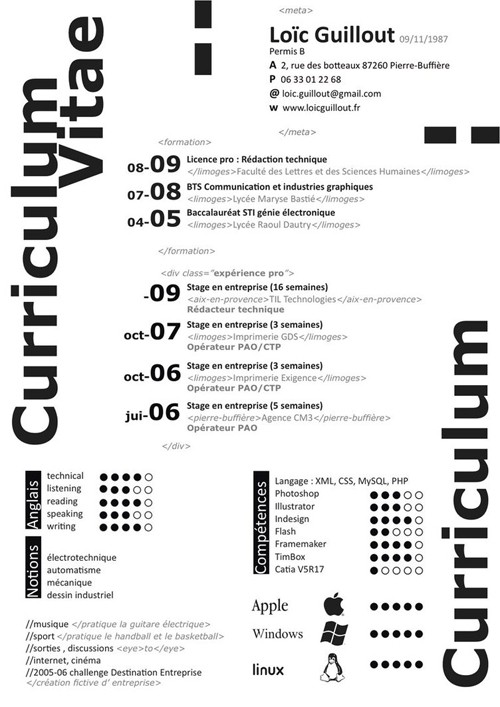

HOMEWORK due before Monday's Class:
Students will choose two researchers in their field who use delicious and write a paragraph (as a blog comment on THIS post) noting:
- The importance of each researcher
- The types of resources each researcher bookmarks
- The clarity and/or style of tagging that each researcher employs
Remember, if you post a comment under an alias, make sure I know who you are by sending me an e-mail!
For those of you who don't read the comments. Here is some additional help:
Some ways to find people using delicious.
You might check out the scientists you have followed on Twitter and see if any of them use delicious (look at their blogs)
You can also do a google search for researchers/key people in your field, have a look at their blogs and see if they have a delicious tag cloud.
I know I was involved with an creative writing new media online course and I was interested in their delicious links: http://www.delicious.com/cwnm
Howard Rheingold, a key player in my field and in new media in general (you might be interested too!): http://delicious.com/hrheingold
I mentioned in class (and on my cv) that I'm part of the Transliteracy Research Group so I keep up to date with those bookmarks too: http://www.delicious.com/transliteracy
Of course, our class is on delicious too: http://delicious.com/ales204
An interesting article on how to use delicious in research: go here
Note: delicious is still working out some bugs due to the move from Yahoo... you can read about it here.
For those of you who don't read the comments. Here is some additional help:
Some ways to find people using delicious.
You might check out the scientists you have followed on Twitter and see if any of them use delicious (look at their blogs)
You can also do a google search for researchers/key people in your field, have a look at their blogs and see if they have a delicious tag cloud.
I know I was involved with an creative writing new media online course and I was interested in their delicious links: http://www.delicious.com/cwnm
Howard Rheingold, a key player in my field and in new media in general (you might be interested too!): http://delicious.com/hrheingold
I mentioned in class (and on my cv) that I'm part of the Transliteracy Research Group so I keep up to date with those bookmarks too: http://www.delicious.com/transliteracy
Of course, our class is on delicious too: http://delicious.com/ales204
An interesting article on how to use delicious in research: go here
Note: delicious is still working out some bugs due to the move from Yahoo... you can read about it here.
Thursday, October 6, 2011
Lecture 14: Strong Presentations and Slideshare
NOTE: No Class on Monday = THANKSGIVING
NO LABS next week!
Death by PowerPoint:
NO LABS next week!
Lecture 14: PPT Presentation Workshop
View more presentations from Jessica Laccetti.
Death by PowerPoint:
Subscribe to:
Posts (Atom)