Showing posts with label workshop. Show all posts

Friday, November 25, 2011

Lecture 30: Interview Analysis

Today's lecture is going to be in two parts. Those of you who have been following along on Twitter, would have seen that we'll have fellow student, Ian McNeill tall us about some software development he's made using what he's learnt in #ALES204. Exciting!

 This is what Ian says about his presentation:


LMS stands for "Learning Management System" and is used in one form or another by practically every company today.  LMS software has a large variety of different purposes, but they all follow the same structural format (Information presentation followed by Testing and online).  Over the last year and a half I have been making my own LMS software and you will notice much of what we learned in ALES 204 has been incorporated into the presentations!

For the second half of the class (if time permits), we'll practise analysing an interview. You will have the opportunity to find an interview related to your interest or field, and then you can analyse it using a google doc which can be found here.

Note: PLEASE make sure you *save a copy* of the google doc rather than simply writing in it! more like a workshop where you'll have most of the class to practise what we've been covering all week.


Wednesday, November 9, 2011

Lecture 24: Online Class

Photo by Jessica Laccetti.


Today is your opportunity to work on your Wikipedia assignment! Take this time to add to your stub. Remember, you need to write 300-600 words AND, since this assignment is also part of your e-portfolio, you need to follow those guidelines.

As a reminder, the Wikipedia assignment is here and the e-portfolio assignment is here and the rubric is here.

Friday, November 4, 2011

Lecture 22: RefWorks Workshop

Today we have Angie, TA to some of you, here to guide us through a hands-on workshop with RefWorks. Diane showed this to us on Wednesday and today we get to really practise using it.

Remember, please tweet three reflections on today's lecture to both myself
(@JessL) and to Angie (@charleston_chiu)

Here is Angie's lecture:


Thursday, November 3, 2011

Labs Module 10

Remember all, those of you in the Thursday lab will need to try to join Monday, Tuesday or Wednesday's lab next week because the university is closed on Thursday so no lab will be running then!!!

Please e-mail your TA for any further help on locations and/or times of labs.

You can also see this blog post about the labs and locations.

Thursday, October 13, 2011

Lecture 16: CV Writing Workshop

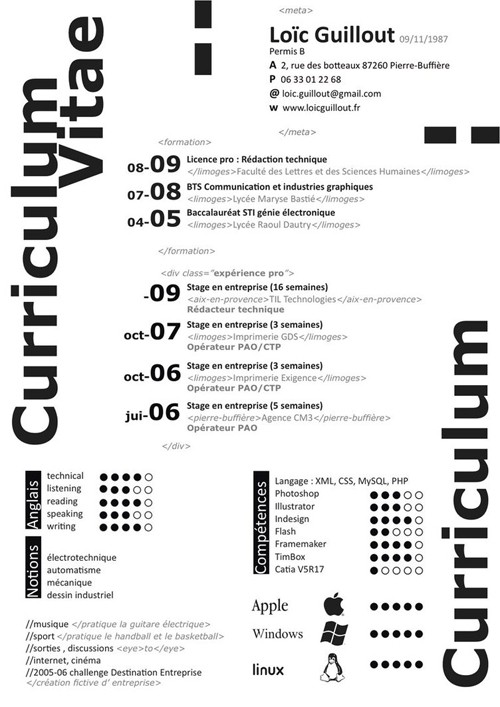
Today the TAs and I are going to show you our own CVs. I have had great luck with mine, landing an interview each time I've used it - so I'm an aficionado of this style. But, there are lots of different styles out there and some exciting ideas. Pamela has suggested looking at the templates over here. Another reminder that we'll be using the more academic version, a CV, rather than the North American version of a résumé:
A curriculum vitae (CV) provides an overview of a person's experience and other qualifications. In some countries, a CV is typically the first item that a potential employer encounters regarding the job seeker and is typically used to screen applicants, often followed by an interview, when seeking employment. The curriculum vitae is comparable to a résumé in many countries, although in English Canada and the United States it is substantially different.
A résumé is a simpler document while the CV is expected to thoroughly outline your education and your professional history (think jobs, volunteer work, publications, presentations etc...). In the words of the University of Waterloo's Career Services:


What is a curriculum vitae?
 A presentation of credentials for a research/teaching position in a university, a research institute,
or company with R&D requirements. A résumé (two pages maximum) is prepared for employers
outside the academic and research environment
 An indispensable job hunting tool that represents an objective, factual, personal history of you -
an advertisement designed to market you by highlighting your abilities and future potential
 A summary of your career aspirations, educational background, employment experience,
achievements, and interests


Key headings to include in your cv:


  • Name
  • Address/Telephone/Email
  • Citizenship

  • Research and/or Professional Inter ests
  • Education/Professional  Training/Certifications
  • Employment
  • Publications
  • Presentations
  • Awards/Scholarships
  • Professional Affiliations
  • Volunteer Work
  • Languages
  • Hobbies


Here are some creative takes on CVs:
Cool Blog Sociale - 10 July 2008 - Creative hire Resume T-shirt by BlackBirdTees B
From McGill University, here is a useful video outlining the elements of a cv. Also from McGill, a very handy cv writing guide.


HOMEWORK due before Monday's Class:


Students will choose two researchers in their field who use delicious and write a paragraph (as a blog comment on THIS post) noting:
      • The importance of each researcher
      • The types of resources each researcher bookmarks
      • The clarity and/or style of tagging that each researcher employs
Remember, if you post a comment under an alias, make sure I know who you are by sending me an e-mail!


For those of you who don't read the comments. Here is some additional help:


Some ways to find people using delicious.


You might check out the scientists you have followed on Twitter and see if any of them use delicious (look at their blogs)


You can also do a google search for researchers/key people in your field, have a look at their blogs and see if they have a delicious tag cloud.


I know I was involved with an creative writing new media online course and I was interested in their delicious links: http://www.delicious.com/cwnm


Howard Rheingold, a key player in my field and in new media in general (you might be interested too!): http://delicious.com/hrheingold


I mentioned in class (and on my cv) that I'm part of the Transliteracy Research Group so I keep up to date with those bookmarks too: http://www.delicious.com/transliteracy

Of course, our class is on delicious too: http://delicious.com/ales204


An interesting article on how to use delicious in research: go here


Note: delicious is still working out some bugs due to the move from Yahoo... you can read about it here.


Sunday, October 2, 2011

Lecture 12: Disseminating Information


This week, Module 5, we will be looking at various ways of sharing our own research. We will cover the idea of posters and academic papers as well as have an opportunity in the labs to practise presenting a poster.


On Monday we have a special visitor, Maira Quintanilha will be coming to give us a short presentation on how she made her poster that WON at the AIHN graduate student competition.

Here is a brief bio of Maira:


Maira Quintanilha began her Master in Science program at the Department of Agricultural Food and Nutrition Sciences at University of Alberta in the Fall of 2009 after completing a Bachelors degree in Nutrition and Food Science and the Integrated Dietetic Internship Program from the Federal University of Goiás in Brazil. 
During her Masters degree at the University of Alberta, Maira has received many awards and scholarships including the Dr. Elizabeth A. Donald MSc Fellowship in Human Nutrition, second place in the 2011 Alberta Institute for Human Nutrition graduate poster competition and two Graf tuition awards. She was also a finalist in the prestigious Nestlé Student and Trainee Competition at the Canadian Nutrition Society Conference in 2010. Her research interests include health promotion, building a school environment that facilitates healthy choices, and nutrition education. She defended her Masters thesis in August 2011 and is currently working on her process to become a Registered Dietitian in Canada.

HOMEWORK: There is a slight change as Marie Claude will be giving a guest lecture in the next class so FOR FRIDAY: please bring to class a paper/article that you have to read for one of your other classes


Lecture Part I: Effective Posters


Lecture Part II: Academic Essay Writing


Group Essay Writing Activity:
https://docs.google.com/document/d/16FhezNuYEFECx8lDy7ctaT2EDkIxoUjDnZquqbwPxS8/edit?hl=en_US


Remember to comment on the blog with any core questions/ideas pertaining to lectures (see Participation on the syllabus) 


Note: I have had a few students ask me about a CV. It is like a résumé, but more detailed. Here is what Colorado State University says:


How a CV is Different from a Resume
Many job search committees for teaching, graduate school, international or research positions request a CV to get a fuller picture of your academic experiences, accomplishments and interests than a resume can provide.
A resume lists your education, experience and skills. Your CV allows you to go beyond listing your relevant experiences and accomplishments; you can also convey the substance of those experiences and accomplishments.
Unlike a resume, which is usually about one page long, CVs vary in length, from about two to five pages, depending on the applicant's relevant experiences.